The True Form of the Nue: Comparing Different Descriptions in Japanese Legends
Introduction
The Nue is one of the most mysterious creatures in Japanese folklore.
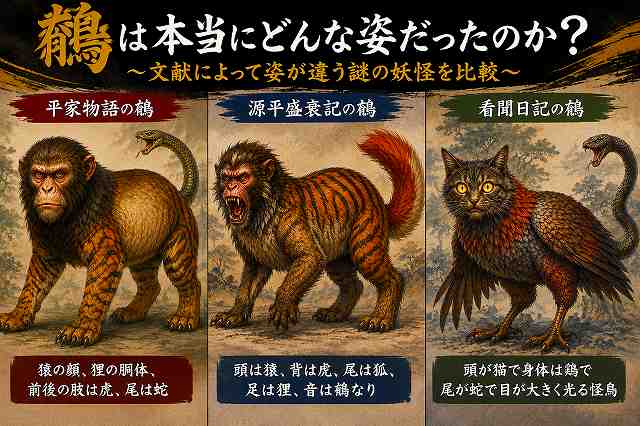
Today, it is usually described as a chimera with the face of a monkey, the body of a raccoon dog, the limbs of a tiger, and the tail of a snake.
However, when we look at historical texts, we find something surprising.
The appearance of the Nue changes dramatically from one source to another.
Some descriptions combine monkeys, tigers, and snakes, while others describe a strange bird-like creature with the head of a cat and the body of a chicken.
If the same creature looks so different in different texts, what was the original Nue?
In this article, we compare historical records and artistic depictions to explore the true identity of one of Japan’s most enigmatic legendary creatures.
What Is a Nue?
The Nue is a mysterious creature that has appeared in Japanese stories since the Heian period (794–1185).
According to legend, it cried out with an eerie voice during the night and brought fear to those who heard it.
The creature is especially famous because of the legend in which the warrior Minamoto no Yorimasa defeated it with an arrow.
Several characteristics are commonly associated with the Nue:
- It has been part of Japanese folklore since the Heian period.
- It is known for its strange and frightening cry.
- It appears in the legend of Minamoto no Yorimasa.
- Its appearance varies greatly depending on the historical source.
Although the Nue is now considered a yōkai, its form was never completely fixed.
To understand its true nature, we first need to compare the different descriptions found in historical texts.
The Most Famous Image of the Nue Today
Today, most people in Japan imagine the Nue as a creature with:
- The face of a monkey
- The body of a raccoon dog
- The limbs of a tiger
- The tail of a snake
This image has become so well known that it is often presented as the “correct" appearance of the Nue.
However, this description comes mainly from one particular source and does not represent all historical traditions.
As we will see, the appearance of the Nue changed considerably from one text to another.
Why Is the Nue Called a Chimera?
Because the Nue combines the features of several animals, it is often compared to a chimera.
In Greek mythology, a chimera is a creature made up of different animals, and the modern image of the Nue seems to fit this description perfectly.
However, there is an important difference.
The Japanese sources do not always describe the Nue in the same way.
Some texts portray it as a four-legged beast, while others describe it as a strange bird-like creature.
For this reason, calling the Nue a “Japanese chimera" is convenient, but it may oversimplify a much more complex tradition.
Different Descriptions of the Nue in Historical Texts
The appearance of the Nue differs greatly depending on the source.
The following table summarizes the best-known descriptions.
| Source | Description of the Nue |
|---|---|
| The Tale of the Heike | Face of a monkey, body of a raccoon dog, limbs of a tiger, tail of a snake |
| Genpei Seisuiki | Head of a monkey, back of a tiger, tail of a fox, legs of a raccoon dog |
| Kanmon Nikki | Head of a cat, body of a chicken, tail of a snake, glowing eyes |
At a glance, these descriptions seem to refer to entirely different creatures.
Some similarities remain, but the details change dramatically from one source to another.
The following sections look at each description in greater detail.
The Tale of the Heike
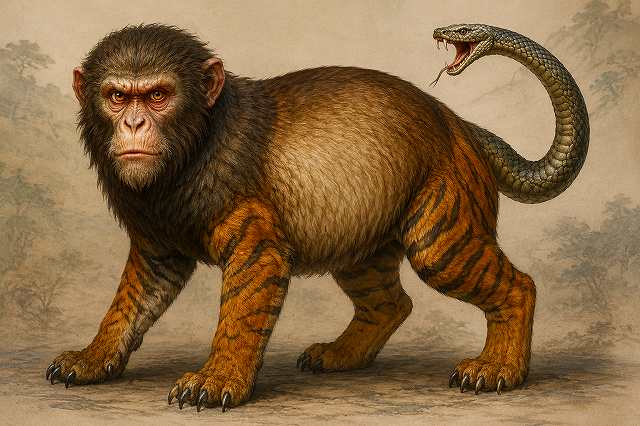
The Tale of the Heike is one of Japan’s most famous medieval epics and tells the story of the conflict between the Taira and Minamoto clans.
This text contains the best-known description of the Nue and greatly influenced the creature’s modern image.
According to the story, the Nue had:
- The face of a monkey
- The body of a raccoon dog
- The limbs of a tiger
- The tail of a snake
It was also said to cry out in the night and bring fear to the imperial court.
Eventually, the warrior Minamoto no Yorimasa shot it down with an arrow and defeated it.
The modern image of the Nue is based largely on this version of the story.
Genpei Seisuiki
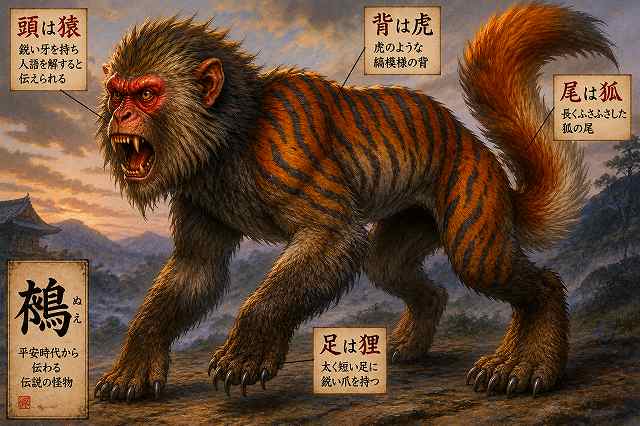
Genpei Seisuiki is a later and more detailed retelling of the Genpei War that contains many legendary and supernatural episodes.
Although it tells a similar story, the appearance of the Nue is slightly different.
According to this text, the creature had:
- The head of a monkey
- The back of a tiger
- The tail of a fox
- The legs of a raccoon dog
At first glance, this creature resembles the version found in The Tale of the Heike.
However, the differences are significant.
The addition of a fox, an animal often associated with supernatural powers in Japanese folklore, makes this version of the Nue even more mysterious.
Kanmon Nikki
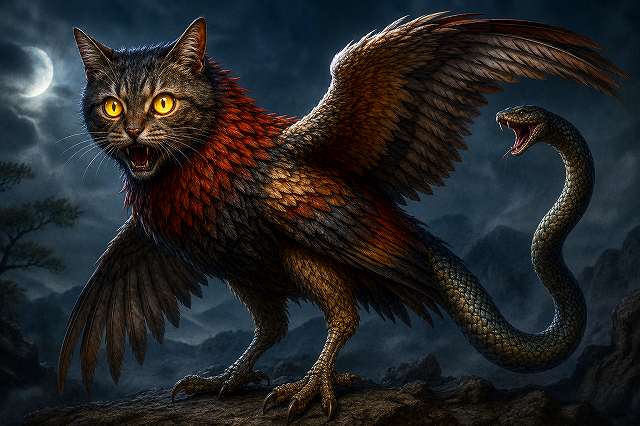
Kanmon Nikki is a fifteenth-century court diary that records unusual events and strange creatures.
The creature described in this source is dramatically different from the earlier versions.
It is portrayed as having:
- The head of a cat
- The body of a chicken
- The tail of a snake
- Large, glowing eyes
This version looks less like a beast and more like a strange bird.
Even so, it retains some features associated with earlier descriptions, particularly the snake-like tail.
This suggests that the Nue may have represented an undefined and frightening creature rather than a monster with one fixed appearance.
Comparing the Three Descriptions
The three descriptions of the Nue are surprisingly different.
The following table makes these differences easier to understand.
| Source | Monkey | Tiger | Fox | Cat | Chicken | Snake |
|---|---|---|---|---|---|---|
| The Tale of the Heike | Yes | Yes | No | No | No | Yes |
| Genpei Seisuiki | Yes | Yes | Yes | No | No | No |
| Kanmon Nikki | No | No | No | Yes | Yes | Yes |
At first glance, these descriptions seem to refer to completely different creatures.
The versions found in The Tale of the Heike and Genpei Seisuiki share several features, particularly the monkey and tiger elements.
The creature described in Kanmon Nikki, however, is dramatically different.
It resembles a mysterious bird rather than a four-legged beast.
This comparison suggests that the Nue did not have one universally accepted appearance.
How Did Edo-Period Artists Imagine the Nue?
The Nue appeared not only in literature but also in the artwork of the Edo period (1603–1868).
Interestingly, different artists imagined the creature in different ways.
Toriyama Sekien’s Nue
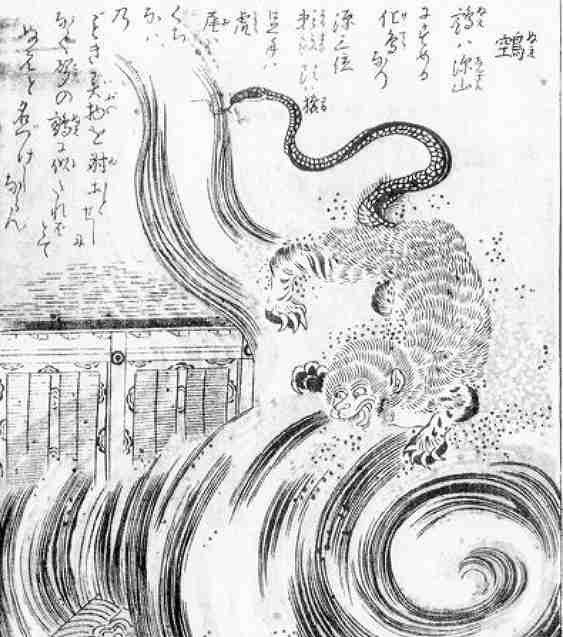
Toriyama Sekien was one of Japan’s most famous artists of yōkai and published several illustrated collections of supernatural creatures.
In his work Konjaku Gazu Zoku Hyakki (The Illustrated Night Parade of a Hundred Demons, Continued), he depicted the Nue as a frightening monster inspired by earlier literary traditions.
Although his version follows the general image found in The Tale of the Heike, it also reflects his own artistic interpretation.
This illustration helped shape the way later generations imagined the Nue.
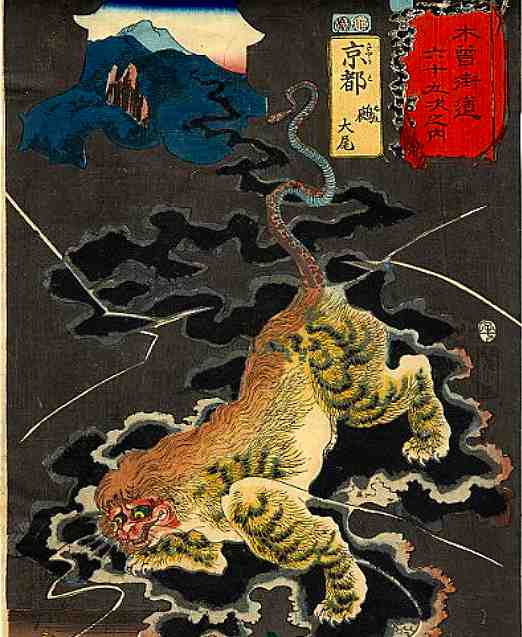
Utagawa Kuniyoshi’s Nue
Utagawa Kuniyoshi, one of the most famous ukiyo-e artists of the nineteenth century, also depicted the Nue.
His version places greater emphasis on the creature’s terrifying and supernatural nature.
As time passed, artists became less concerned with preserving a single traditional appearance and more interested in expressing the mystery and fear associated with the creature.
Why Did the Appearance of the Nue Change?
Why does the Nue look so different from one source to another?
Several factors may explain these changes.
- Local traditions developed in different ways.
- The feeling of fear was more important than a precise appearance.
- Writers and artists added their own interpretations.
Unlike creatures such as the Kirin, which usually maintain a relatively stable appearance, the Nue was primarily defined by its mysterious and frightening nature.
As a result, its exact form remained flexible and could change from one generation to another.
Over time, new interpretations were added, and the creature gradually took on different appearances.
What Was the Original Nue?
So what was the original form of the Nue?
The answer remains uncertain.
The following table highlights the main animals that appear in each source.
| Source | Monkey | Tiger | Fox | Cat | Chicken | Snake |
|---|---|---|---|---|---|---|
| The Tale of the Heike | Yes | Yes | No | No | No | Yes |
| Genpei Seisuiki | Yes | Yes | Yes | No | No | No |
| Kanmon Nikki | No | No | No | Yes | Yes | Yes |
The monkey and tiger elements appear in both The Tale of the Heike and Genpei Seisuiki, suggesting that these features may represent an older tradition.
However, all of these texts are legends and literary works rather than eyewitness accounts.
Because of this, it is impossible to determine the creature’s original appearance with certainty.
Some scholars have even suggested that the earliest Nue may not have been a physical creature at all.
In ancient Japan, the word “nue" originally referred to a bird with an eerie cry, and the legendary monster may have developed from the fear associated with its mysterious call.
If this interpretation is correct, the Nue was never meant to have one fixed form.
Instead, it gradually became a symbol of the unknown and the frightening.
Conclusion
Today, the Nue is usually described as a creature with the face of a monkey, the body of a raccoon dog, the limbs of a tiger, and the tail of a snake.
However, historical sources tell a much more complicated story.
Genpei Seisuiki adds a fox to the creature’s appearance, while Kanmon Nikki describes something entirely different: a strange bird-like creature with the head of a cat and the body of a chicken.
Later artists also reinterpreted the Nue and created their own versions of the legendary monster.
Rather than being a creature with one fixed appearance, the Nue seems to have changed over time as stories and beliefs evolved.
Perhaps that uncertainty is precisely what makes the Nue one of the most fascinating creatures in Japanese folklore.
Related Articles