Kappa, Enkō, and Garappa: How Japan’s Water Spirits Differ by Region
Introduction
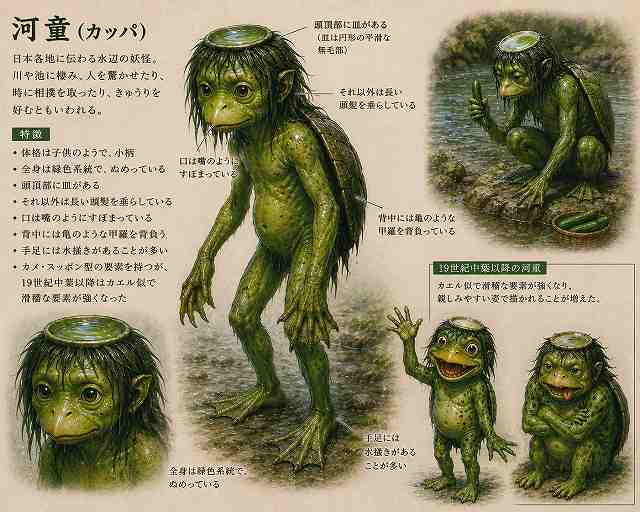
When people hear the word “Kappa," they often imagine a green creature with a turtle shell and a dish of water on its head.
However, similar water spirits can be found throughout Japan under different names and with very different appearances.
In Shikoku, there is the Enkō, a hairy creature that resembles a monkey. In Kyushu, people tell stories about the Garappa, a long-armed water spirit.
Are these creatures all the same yōkai, or are they entirely different beings?
In this article, we compare Kappa, Enkō, and Garappa and explore how Japan’s regional legends shaped these mysterious water spirits.
Are Kappa Found Throughout Japan?
Kappa are known throughout Japan, but their names and appearances vary from region to region.
In Shikoku, similar creatures are called Enkō. In parts of Kyushu, they are known as Garappa.
All of these beings are associated with rivers, ponds, and other bodies of water. They are often described as creatures that surprise people, drag them into the water, or cause mysterious accidents.
The following table shows some of the most famous regional names.
| Region | Name |
|---|---|
| Most of Japan | Kappa |
| Shikoku | Enkō |
| Kyushu | Garappa |
This shows that Japan does not share a single, uniform image of the Kappa.
Instead, local traditions created different versions of water spirits over many centuries.
What Does a Kappa Look Like?
The modern image of the Kappa is one of Japan’s most recognizable yōkai.
According to popular tradition, a Kappa usually has:
- The body size of a child
- Green, slippery skin
- A dish filled with water on its head
- A turtle-like shell on its back
- Webbed hands and feet
- Long hair
This familiar image gradually developed between the Edo period and the Meiji period and eventually became the standard appearance of the Kappa in Japanese popular culture.
What Is Enkō?
In Shikoku, a creature called Enkō (猿猴) has long been part of local folklore.
According to traditional stories, Enkō has several distinctive characteristics:
- It is covered in hair and resembles a monkey.
- It is about the size of a three-year-old child.
- It has a red face.
- It has long arms and legs with claws.
- Its body is slippery like a catfish.
- Its arms can stretch to unusual lengths.
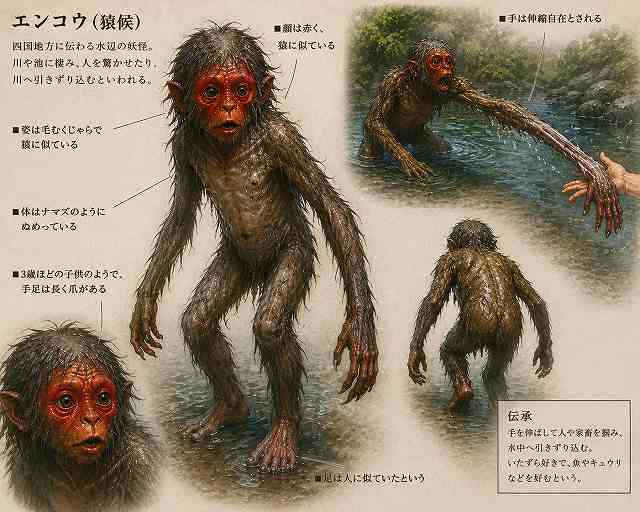
Unlike the modern Kappa, Enkō does not usually have a turtle shell or green skin.
Instead, it is often portrayed as an ape-like creature.
However, it shares many similarities with the Kappa, including its association with water and its tendency to pull humans into rivers and ponds.
What Is Garappa?
In parts of Kyushu, people tell stories about a water spirit called Garappa.
Garappa is often described as having the following features:
- Longer arms and legs than a typical Kappa
- A body covered in hair
- The ability to walk upright
- Brownish skin
- A dish on its head
- Stretchable arms
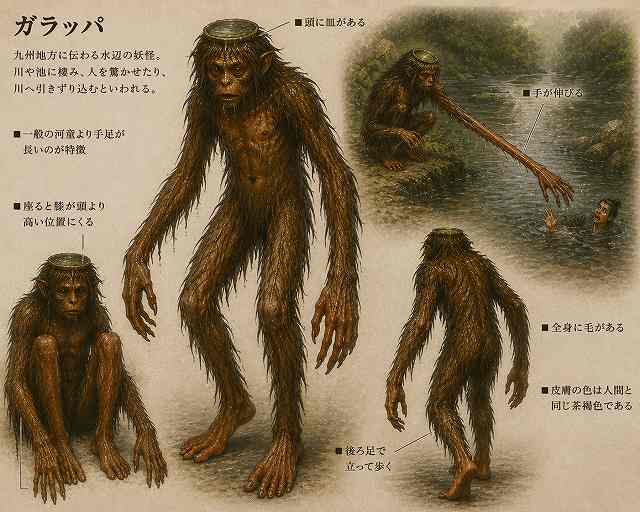
Garappa seems to be something of a middle ground between the Kappa and the Enkō.
Like the Enkō, it is hairy. Like the Kappa, it has a dish on its head.
Because of these mixed characteristics, some researchers believe that Garappa may represent a regional variation of the Kappa tradition rather than an entirely separate creature.
Comparing Kappa, Enkō, and Garappa
Although these creatures are all considered water spirits, their appearances are surprisingly different.
【Insert Image 5 Here】
Caption:
A comparison of Kappa, Enkō, and Garappa based on regional folklore.
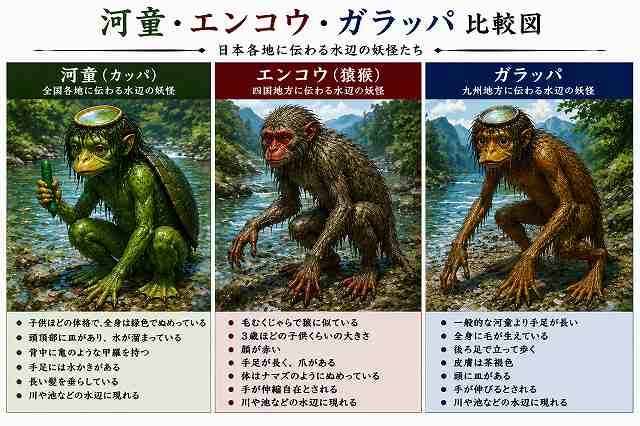
| Feature | Kappa | Enkō | Garappa |
|---|---|---|---|
| Dish on the head | Yes | Varies by legend | Yes |
| Turtle shell | Yes | No | No |
| Hair | No | Yes | Yes |
| Green skin | Yes | No | No |
| Monkey-like appearance | No | Yes | No |
| Stretchable arms | Sometimes | Yes | Yes |
| Lives near water | Yes | Yes | Yes |
The Kappa is known for its turtle shell and green skin, while both Enkō and Garappa are often described as hairy creatures.
Enkō is particularly notable for its monkey-like appearance, whereas Garappa is known for its long limbs and unusual body shape.
Despite these differences, all three creatures are associated with rivers and ponds and are said to interact with humans in similar ways.
Why Do These Creatures Look Different?
At first glance, Kappa, Enkō, and Garappa seem too different to be the same creature.
So why did such different traditions develop?
Several factors may explain these regional variations:
- Local legends developed independently.
- The creatures were influenced by the animals and natural environment of each region.
- Storytellers gradually added new characteristics over time.
For example, Enkō resembles a monkey.
Since monkeys were familiar animals in the mountains of Shikoku, local people may have imagined a water spirit that shared some of their features.
Garappa, on the other hand, is usually described as a hairy creature with long arms and legs.
Its appearance may have been shaped by the unique folklore traditions of southern Kyushu.
These examples suggest that people in different regions created their own versions of mysterious water spirits based on the nature and animals around them.
Are They Really the Same Creature?
The similarities between these creatures are just as interesting as their differences.
All three:
- Live near rivers, ponds, or other bodies of water.
- Are associated with dangerous encounters with humans.
- Have human-like features.
- Are considered supernatural beings rather than ordinary animals.
At the same time, their appearances vary greatly.
The Kappa has a turtle shell and green skin.
The Enkō looks like a hairy monkey.
The Garappa combines features of both creatures and has long, hairy limbs.
Because of this, it may be more accurate to think of Kappa, Enkō, and Garappa as regional water spirits that gradually became associated with one another rather than as exactly the same creature.
Why Did Only the Kappa Become Standardized?
An interesting question remains: why is the Kappa recognized throughout Japan, while Enkō and Garappa remain local legends?
One possible answer lies in art and popular culture.
From the Edo period onward, illustrated books, woodblock prints, and popular stories frequently depicted the Kappa as a creature with:
- A dish on its head
- A turtle shell
- Webbed hands and feet
As these images spread throughout the country, they gradually became the “standard" image of the Kappa.
Regional creatures such as Enkō and Garappa continued to exist in local folklore, but they eventually came to be regarded as variations of the better-known Kappa.
In other words, the modern Kappa is the result of centuries of storytelling and artistic tradition.
Conclusion
Many people assume that the Kappa has always had the same appearance throughout Japan.
However, local traditions tell a different story.
In Shikoku, there is the monkey-like Enkō.
In Kyushu, there is the hairy and long-armed Garappa.
Although these creatures look very different, they share many important characteristics, especially their connection to water and their mysterious interactions with humans.
This suggests that the Kappa may not be a single creature at all.
Instead, it may be a collection of regional water-spirit traditions that gradually came together under one famous name.
Exploring these regional legends reveals just how rich and diverse Japanese folklore truly is.
Related Articles