What Is the Kirin? The Original Appearance of Japan’s Mythical Qilin
When people hear the word “Kirin," many imagine a majestic creature with a dragon-like face, scales, and flowing mane.
However, ancient Chinese texts describe something rather different.
The oldest sources mention only a few characteristics: a deer-like body, an ox-like tail, and a single horn. They say almost nothing about scales or dragon features.
So what did the original Kirin really look like?
By examining ancient texts and comparing them with modern depictions, we can see how this legendary creature gradually changed over time.
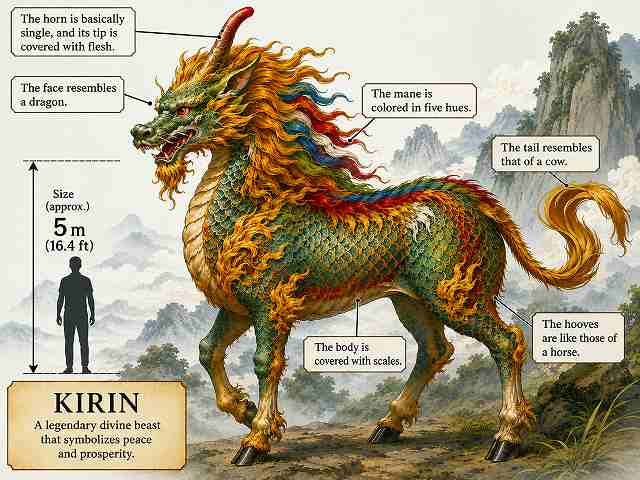
What Is the Kirin?
The Kirin, known in Chinese as the Qilin (pronounced “chee-lin"), is a legendary beast that originated in Chinese mythology and later became part of Japanese folklore.
Traditionally, the Kirin is:
- A creature that appears during peaceful and prosperous times.
- A sign of the arrival of a wise ruler or sage.
- One of East Asia’s most sacred mythical creatures, alongside the dragon and phoenix.
Rather than being a fearsome monster, the Kirin symbolizes peace, virtue, and good government.
Why Was the Kirin Considered a Good Omen?
Ancient traditions describe the Kirin as an exceptionally peaceful creature.
Some texts even say that it avoids stepping on insects or damaging plants. Because of this compassion, it became a symbol of benevolent rulers and harmonious societies.
The appearance of a Kirin was therefore considered a sign that an ideal age had arrived.
Is the Kirin the Same as the Chinese Qilin?
The Japanese Kirin and the Chinese Qilin refer to the same legendary creature, but their depictions are not always identical.
The creature originated in ancient China and was later introduced to Japan along with other elements of Chinese culture.
Over time, Japanese art and folklore developed their own interpretations of the Kirin. As a result, modern Japanese depictions sometimes differ from Chinese ones in appearance and symbolism.
For this reason, English-language sources often use both names depending on the cultural context.
How Do Ancient Texts Describe the Kirin?
Modern illustrations often show the Kirin with scales and a dragon-like face. Yet the earliest texts paint a much simpler picture.
| Source | Description |
|---|---|
| Shuowen Jiezi | Body of a large deer, tail of an ox, and a single horn |
| Chunqiu Gongyang Zhuan Jiegu | A single horn with flesh covering its tip |
| Da Dai Li Ji | The leader of all fur-bearing creatures |
| Modern depictions | Dragon-like face, scales, colorful fur |
Characteristics Shared by Ancient Sources
By combining these texts, several common traits emerge:
- A deer-like body
- An ox-like tail
- Usually a single horn
- A symbol of benevolence and virtue
Notably absent are many of the features that people now associate with the Kirin.
What Would the Kirin Look Like Based Only on Ancient Descriptions?
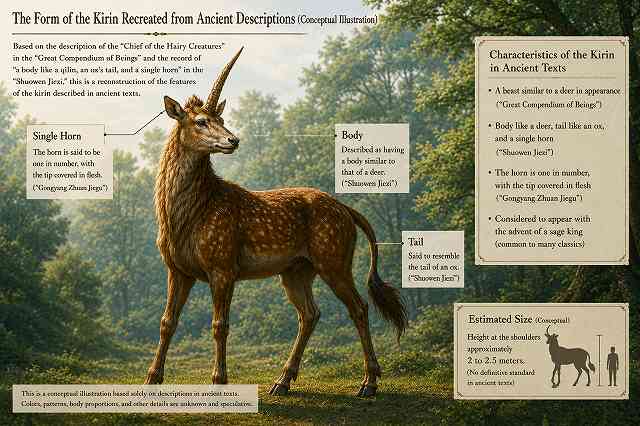
If we reconstruct the Kirin using only the information found in ancient texts, one possible interpretation resembles a large deer with a mysterious horn.
There are no scales and no serpent-like features. It appears much closer to a real animal than to the fantastical creature seen in modern art.
Of course, this reconstruction remains speculative. The ancient sources simply do not provide enough information to recreate the creature with certainty.
What the Ancient Texts Don’t Tell Us
The old texts leave many important questions unanswered.
For example, they rarely mention:
- The shape of the face
- The creature’s color
- Its exact size
- Whether it had a mane
- Whether it had scales
Because the descriptions are so limited, later generations were free to imagine the Kirin in many different ways.
Was the Kirin Really Dragon-Like?
When we compare ancient descriptions with modern illustrations, the differences become obvious.
| Feature | Ancient Kirin | Modern Kirin |
|---|---|---|
| Body | Deer-like | Deer mixed with dragon traits |
| Tail | Ox-like | Often lion-like or decorative |
| Horn | Usually one | One or two |
| Face | Unknown | Frequently dragon-like |
| Scales | Rarely mentioned | Commonly depicted |
| Fur | Hair or fur | Often shown in multiple colors |
The majestic appearance that many people recognize today is largely a product of later artistic interpretation.
Why Did the Modern Kirin Become Dragon-Shaped?
Ancient texts provide only limited details about the creature’s appearance.
As artists and storytellers continued to depict the Kirin over the centuries, they gradually added features associated with other sacred creatures, particularly dragons and phoenixes.
Because the Kirin symbolized good fortune and royal authority, it also became increasingly majestic and supernatural in appearance.
The result is the magnificent Kirin that appears in paintings, sculptures, and modern popular culture.
Like the Kirin, many legendary beings changed dramatically over time. The Tengu, for example, evolved from a mysterious celestial phenomenon into the long-nosed mountain spirit known today.
Why Is the Giraffe Called “Kirin" in Japan?
In modern Japanese, the word “kirin" usually refers to a giraffe.
This connection dates back to the early fifteenth century during the reign of the Yongle Emperor of the Ming dynasty.
When the explorer Zheng He returned from East Africa, a giraffe was brought to the Chinese court. Because the animal was unlike anything the court had seen before, it became associated with the legendary Qilin and was regarded as an auspicious sign.
Although a giraffe does not perfectly match the ancient descriptions of the mythical beast, the name has remained in use ever since.
Frequently Asked Questions
Is the Kirin a dragon?
No. Ancient texts do not describe the Kirin as a dragon. The dragon-like appearance commonly seen today developed through later artistic traditions.
Is the Kirin the same as a giraffe?
No. The giraffe was associated with the Qilin during the Ming dynasty, but it is a real animal and not the mythical creature itself.
Is the Kirin Japanese or Chinese?
The creature originated in ancient Chinese mythology and later became part of Japanese folklore and art.
Final Thoughts
The original Kirin described in ancient texts was probably very different from the creature familiar today.
Many of the earliest sources describe the Kirin as a deer-like animal with an ox-like tail and a single horn. Numerous features now associated with the Kirin were added centuries later through art and storytelling.
Comparing ancient records with modern depictions reveals something fascinating: mythical creatures are not fixed in form. They evolve alongside the cultures that imagine them.
References
- Xu Shen, Shuowen Jiezi
- Chunqiu Gongyang Zhuan Jiegu
- Da Dai Li Ji
Related Articles