What Does the Japanese Symbol “ヶ” Mean? Why It Isn’t the Katakana ケ
Have you ever wondered why Japanese words such as 1ヶ月 (ikkagetsu), 3ヶ所 (sankasho), or 霞ヶ関 (Kasumigaseki) contain a tiny ヶ?
Many people assume it is simply a small version of the katakana ケ.
In fact, it is not a katakana character at all.
The symbol ヶ has long been used in Japanese to represent the counter 箇 (ka) in words related to quantity and in many place names.
Although it closely resembles ケ, it has a different origin and serves a different purpose.
In this article, you’ll learn what ヶ really is, why it looks like ケ, how it is used in modern Japanese, and why it should not be confused with the katakana character.
What Does the Japanese Symbol “ヶ" Mean?
The symbol ヶ is not a kanji or a katakana character.
Instead, it is a special symbol derived from the kanji 箇, which is commonly used as a counter in Japanese.
Today, ヶ mainly appears in two situations.
- Expressions of quantity, such as 1ヶ月 (“one month") and 3ヶ所 (“three places").
- Place names, such as 霞ヶ関 and 駒ヶ岳.
Although many Japanese speakers casually refer to it as a “small ケ," language authorities such as the NHK Broadcasting Culture Research Institute explain that ヶ is derived from 箇, not from the katakana ケ.
There are two widely accepted explanations for its origin.
One is that it developed from 个, a historical abbreviated form of 箇.
The other is that it originated from one half of the bamboo radical (⺮) in the character 箇.
Because both explanations appear in reliable references, modern dictionaries and language guides often introduce them together rather than choosing one as the only correct origin.
Why Is “ヶ" Not the Same as “ケ"?
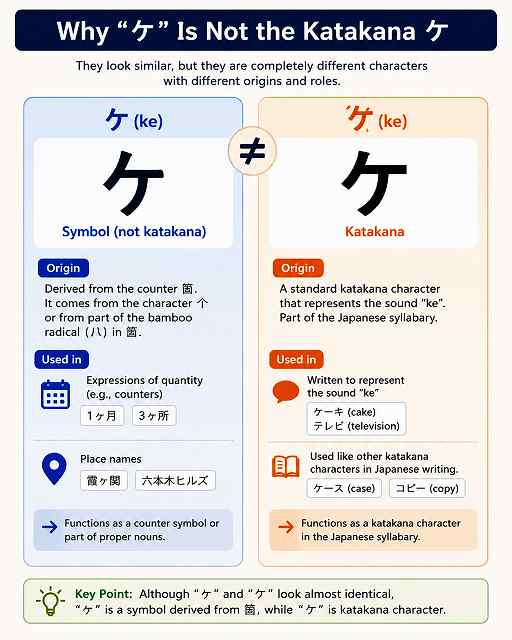
Although ヶ and ケ look almost identical, they are different characters with different origins and functions.
The table below summarizes the main differences.
| ヶ | ケ |
|---|---|
| Derived from the counter 箇 | A katakana character |
| Used in counters and place names | Part of the Japanese syllabary |
| Represents a symbolic abbreviation | Represents the sound ke |
This distinction is important because the two characters serve completely different purposes.
For example, 1ヶ月 uses ヶ because it represents the counter derived from 箇.
By contrast, words such as ケーキ (“cake") use the katakana ケ, which represents the syllable ke.
Although the shapes are similar, their history and usage are unrelated.
Where Is “ヶ" Used?
The symbol ヶ appears mainly in expressions of quantity and in proper names.
The following examples show some of its most common uses.
| Example | Reading | Meaning |
|---|---|---|
| 1ヶ月 | ikkagetsu | one month |
| 3ヶ所 | sankasho | three places |
| 霞ヶ関 | Kasumigaseki | a district in Tokyo |
| 駒ヶ岳 | Komagatake | Mount Komagatake |
In expressions of quantity, ヶ usually represents the counter derived from 箇.
In place names, however, its pronunciation depends on the official reading of each name.
For example, 霞ヶ関 is read Kasumigaseki, while 駒ヶ岳 is read Komagatake.
Because these are proper names, their established readings should always be respected rather than guessed from the symbol itself.
Why Does “ヶ" Look Like “ケ"?
If ヶ is not the katakana ケ, why do they look almost identical?
There are two widely accepted explanations for its shape.
The first is that ヶ developed from 个, a historical abbreviated form of the kanji 箇.
According to Kanjigen, 个 was used as a simplified form of 箇 from the Han dynasty onward.
The second explanation is that ヶ originated from one half of the bamboo radical (⺮) found at the top of 箇.
This interpretation is also introduced by Kanji Culture Resource Center(漢字文化資料館).
Today, Japanese language references often present both explanations together.
Rather than treating one as definitively correct, they acknowledge that both have been accepted in discussions of the symbol’s origin.
Which Is Correct: か月, ヶ月, or ヵ月?
Japanese uses several spellings for expressions such as “one month."
The table below summarizes the most common forms.
| Expression | Typical Usage |
|---|---|
| か月 | Preferred in official documents, school textbooks, and NHK broadcasts |
| ヶ月 | Widely used in newspapers, books, and everyday writing |
| ヵ月 | Used by some publishers and organizations |
Among these forms, か月 is generally regarded as the standard in official writing.
However, ヶ月 is also widely accepted in everyday Japanese and is not considered incorrect.
The preferred spelling often depends on the writing style or editorial policy of the publisher.
Is “ヶ" a Katakana Character?
Despite its appearance, ヶ is not a katakana character.
In Unicode, ヶ is encoded separately from both ケ and ヵ, reflecting the fact that they are different characters with different origins.
For example:
- ヶ (U+30F6) is the symbol derived from 箇.
- ケ (U+30B1) is the standard katakana character ke.
- ヵ (U+30F5) is the small katakana ka.
Although these characters may look similar, they should not be treated as interchangeable.
Understanding this distinction helps explain why ヶ appears in counters and place names, while ケ and ヵ belong to the Japanese katakana writing system.
Conclusion
The Japanese symbol ヶ is often mistaken for a small katakana ケ, but it actually has a different origin.
It is a symbol derived from the counter 箇 and is widely used in expressions of quantity and in many Japanese place names.
Because ヶ, ケ, and ヵ are separate characters with different histories and purposes, recognizing their differences provides a deeper understanding of written Japanese.
Another unique Japanese writing symbol is 々, the kanji repetition mark used in common words such as 人々 and 時々.
Learning how these symbols work will help you read Japanese more naturally.
Another unique symbol in Japanese writing is 々, the kanji repetition mark used in common words such as 人々 and 時々.
If you’re interested in how Japanese repeats kanji without writing the same character twice, be sure to read our detailed guide.
→ What Does the Japanese Symbol “々" Mean? A Complete Guide to the Kanji Repetition Mark
References
- Unicode Consortium. CJK Symbols and Punctuation.
- 漢字文化資料館. 「か」「ケ」の使い分け.
- Kanjigen (Gakken), entries for 个 and 箇.